Secret Messages
Twilight of the Meaning of Our Lives

First of all, sorry if it sounds like a bloody mess—it does. I’ve been editing this article for a few months (and made the mistake of releasing it prematurely, which I regret), as it’s truly my most difficult one. It’s still inconsistent in voice, overloaded with quotes, and full of redundancies. But I can’t keep polishing it forever. To show how bad it is, let me start with this long epigraph.
It is a twilight that generally envelops the meanings of our words.
Ludwig Wittgenstein
I'm living in twilight.
Electric Light Orchestra, Telephone Line
The wind blows [The Spirit breathes] where it wishes, and you hear the sound [voice] of it, but cannot tell where it comes from and where it goes.
John 3:8
The Vagueness of Life’s Stories
I liked detective stories when I was a kid (I can’t explain why I never read them anymore). It was exciting to follow the narrative and guess the hidden script of the plot. It takes real mastery for the author to camouflage the true underlying motives and, at the same time, create believable characters that make you want to follow them. And in the end, when I finally discover what really happened, I would always want to revisit—at least in memory—the trail of events, to compare my views “before and after” down to the last detail. Funny thing is, even though the sequence of previous observations may have led me to the wrong conclusion, the believable characters would typically become even more believable.
In real life, people are not as polarized as in Hollywood movies—far fewer pure villains or pure angels—which often just reflects the fact that people are more complex and... boring at the same time. So the plot is shredded into myriads of tiny paths, disappearing from view.
I once noticed that the best stories are always unpredictable, yet their best characters rarely are. That may sound like an overgeneralization. And yet, you often want the heroes to behave in a certain way. However, the element of chaos, uncertainty, and surprise in the plot should always be welcome—for the very same reason Alan Watts pointed out below: there is no fun without a certain level of chaos.
The dark side of life has its integral part in the game just as every drama must have its villain, to disrupt the status quo, and as the cards must be shuffled, thrown into chaos, in order that there may be a significant development of the play.
Alan Watts
In Western culture, however, your personal story had better be predictable—what a surprise. You are quite certainly expected to act and deliver results, starting at around the age of five: good behavior, good grades, good money, wrapped presents. Your parents, teachers, lovers, spouses, colleagues, bosses, your kids, your grandkids—they’re all in this demanding queue. Chaos and uncertainty are not your friends. It feels safer to expect things to be managed in order. The older you get, the more reliably you try to play your game. Seems like a contradiction to me—because where is the fun part then?
So, how do you get along with this ordinary life? Is it the case that our life story is always vague—as if we lived in the twilight?
And if yes, what can we do with that1?
Ordinary and Yet Good Life
I see a shared understanding between Zen culture and Orthodox Christianity: you can't truly improve things just by forcing effort in one direction.
In Zen it is more subtle; in Christian culture it is even more radical: man can’t do anything truly useful or meaningful without God—not even justify himself by his deeds. That’s one of the most paradoxical themes in Christianity. “Abraham believed God, and it was accounted to him for righteousness.” No one gets what they deserve—in all senses. What you need as a Christian is the grace of the Holy Spirit—something that cannot be earned, because it is given freely. (And yet, some still try to extort it.)
I have always been fascinated by the law of reversed effort. Sometimes I call it the “backwards law.” When you try to stay on the surface of the water, you sink; but when you try to sink, you float. When you hold your breath, you lose it—which immediately calls to mind an ancient and much neglected saying, “Whosoever would save his soul shall lose it.”
Alan Watts, The Wisdom of Insecurity
So, if effort is not rewarded, what is?
For Christians, what is truly rewarded by God is humility:
Lord rewards not for the effort, but humility.
Isaac the Syrian
But before we cast our pearls too far, let’s try to look at this objectively. At the beginning of life, you play the ovary lottery. Depending on your luck and circumstances—what country you're born in, what family you land in—you may succeed in one way or another. But ultimately, you can only achieve very little by yourself. The rest is “guaranteed” by your genes, parents, a little luck, etc.
That said, I truly believe that everyone has both destiny and free will at the same time. How is that possible, you might ask? Let me leave this for you in the twilight.
I suggest you (re)consider your life decent and good, whether you find yourself religious or not. You always know if you fit in. And sometimes, it is already enough not to be “a monster” like Rolf Dobelli mentioned:
You're not responsible for the state of the world. It sounds harsh and unsympathetic, but it's the truth. […] Lead an upright, productive life, and don't be a monster. Follow that advice and you'll already be contributing to a better world.
Rolf Dobelli
As for the recipe, I cannot say better than St. Paul:
Let every man abide in the same calling wherein he was called. Art thou called being a servant? care not for it: but if thou mayest be made free, use it rather. […] Ye are bought with a price; be not ye the servants of men.
1 Corinthians 7:20-23
“In the waters beneath the earth”
Sometimes, we spend years trying to figure out our perfect story. But maybe it’s enough to let the story write us—when you do not deny the Spirit (wind) Who “breathes (blows) where it wishes.” When you understand that you cannot do anything to resolve seemingly unbearable situations in your life, you should stop ‘clinging’. However instead of falling and vanishing in the abyss, you may find a “new heaven and a new earth.” That's why “samsara is truly nirvana.” And once again, I find Orthodox Christianity and Zen resonate perfectly with each other. The man should never deny the Spirit (Wind).
When a person comes to himself, he comes to be one with his own feelings. And that is the only way to control them. The sailor always keeps the wind in his sail. Whether he wants to sail with the wind or against it, he always uses the wind. He never denies the wind.
Alan Watts
It seems to me we’ve been receiving messages all along. Subtle ones—through your loved ones, your circle of friends, the people you talk to. Through the sound that comes “from heaven like the rush of a mighty wind.” But never as a precise instruction of what to do.
I was often utterly confused. Sometimes in my life, I considered certain events to be grave mistakes, and yet they turned out to be grace. Sometimes you just had no idea.
If I had known even some facts about the future many years ago:
—I'd have been greatly surprised.
—I wouldn't have believed half of it.
—I wouldn't have understood the other half.
—I'd have drawn completely wrong conclusions.
—I'd have ruined everything.
Which makes time travel ultimately useless.
The twilight of those messages envelops them in a cloud of vagueness, their meaning hidden “in the waters beneath the earth.” Yet those waters are often the final refuge for a strayed and humbled soul.
It is a fact that ash will not live where the water is too clear. But if there is duckweed or something, the fish will hide under its shadow and thrive. Thus, the lower classes will live in tranquility if certain matters are a bit overlooked or left unheard.
Hagakure
A Script for Your Life
I could not find a script of my life. I believe that script does not exist not for me, not for anyone. I could think about what I’ve achieved so far though. In retrospect, everything often looks logical—but if you had kept a diary back then, things probably didn’t feel so straightforward at the time.
Most of the time, you're not in control. Some people find that deeply unsettling, so they chase the illusion of control. Yet if you really think about it, you might realize how little actually depends on you.
Most people are in constant opposition to themselves because they think that they must be in control.
Alan Watts
I came across a little book To Aid Those Who Repent by Ignatius Bryanchaninov, a glorified Russian saint. The chapter on avarice (love of money) struck me with this definition of sin: fear of old age, unexpected poverty, illness, and exile. Who would have thought that was a sin? And yet, it’s one of many.
Since you can do nothing without the Lord, fear nothing, even when it is not clear (yet) where your path “comes from and where it goes”.
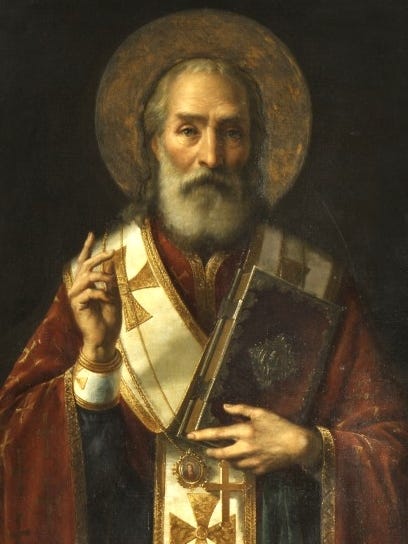
If you haven’t visited Bari yet, you might still be under the illusion that you're in control. Because when nothing else helps, that’s the last resort. This is my secret message to you.